
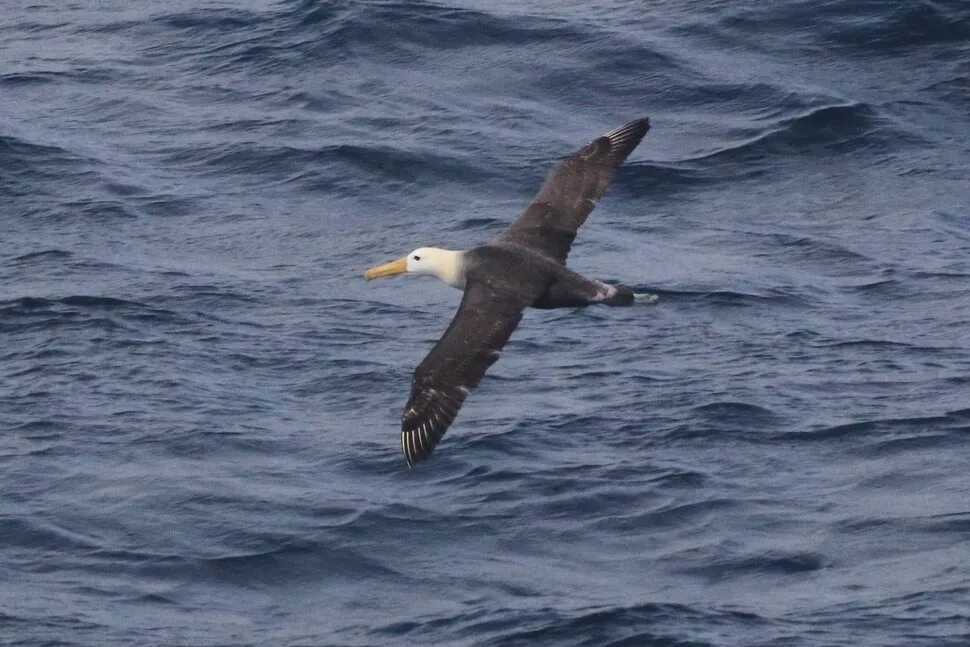

A massive visitor with an 8-foot wingspan has just turned the California coast into a front-row seat for a biological mystery. Scientists aboard a research vessel recently went into “shock” after spotting a Waved Albatross—a critically endangered seabird that usually calls the Galapagos Islands home—soaring 3,000 miles away from its typical tropical range.
This marks only the second time in history the species has been recorded north of Central America, leaving experts to wonder if this “vagrant” is a lone adventurer or a feathered harbinger of a changing climate.
The Rare Sighting at Point Piedras Blancas
The yellow-billed giant was spotted approximately 23 miles off the coast of Point Piedras Blancas, a scenic stretch roughly midway between San Francisco and Los Angeles. Despite being thousands of miles from its nesting grounds on Galapagos lava fields, the adult bird appeared unbothered by its detour.
“It doesn’t seem to be in a hurry to get back south,” noted Tammy Russell, a marine ornithologist with the Farallon Institute and UC San Diego’s Scripps Institution of Oceanography. Interestingly, evidence suggests this might be a return visitor; a similar bird was reported off the Northern California coast just this past October.
Why the 3,000-Mile Detour?
Identifying the exact “why” behind such a massive migration is nearly impossible, but researchers have a few working theories:
| Potential Cause | Description |
| Environmental Factors | Powerful storms or marine heatwaves may have pushed the bird northward. |
| Food Shortages | Albatrosses are known to travel vast distances in search of fish, squid, and crustaceans. |
| A “Gap Year” | Since chicks leave nests by January, this adult may simply be wandering during its non-breeding season. |
| The “Fluke” Factor | Some individual birds simply possess a “rambling spirit” and wander far off course by accident. |
A Warning for the Pacific?
While Marshall Iliff of the Cornell Lab of Ornithology suggests there is no evidence yet that this is anything more than a “fluke accident,” others are keeping a close eye on the thermometer.
Tammy Russell pointed out that five species of Booby—another tropical bird—have already become common sights in California waters due to warming temperatures. If more Waved Albatrosses begin appearing, this lone wanderer may have provided the “baseline data” for a major species shift driven by a heating ocean.
Takeaways
- Species Status: The Waved Albatross is the largest bird in the Galapagos and is currently listed as critically endangered.
- Longevity: These birds can live up to 45 years, spending most of their lives airborne over the open sea.
- The Mystery: It remains unknown if the bird will ever return to its mate in the Galapagos or if it will remain a permanent resident of the California current.