

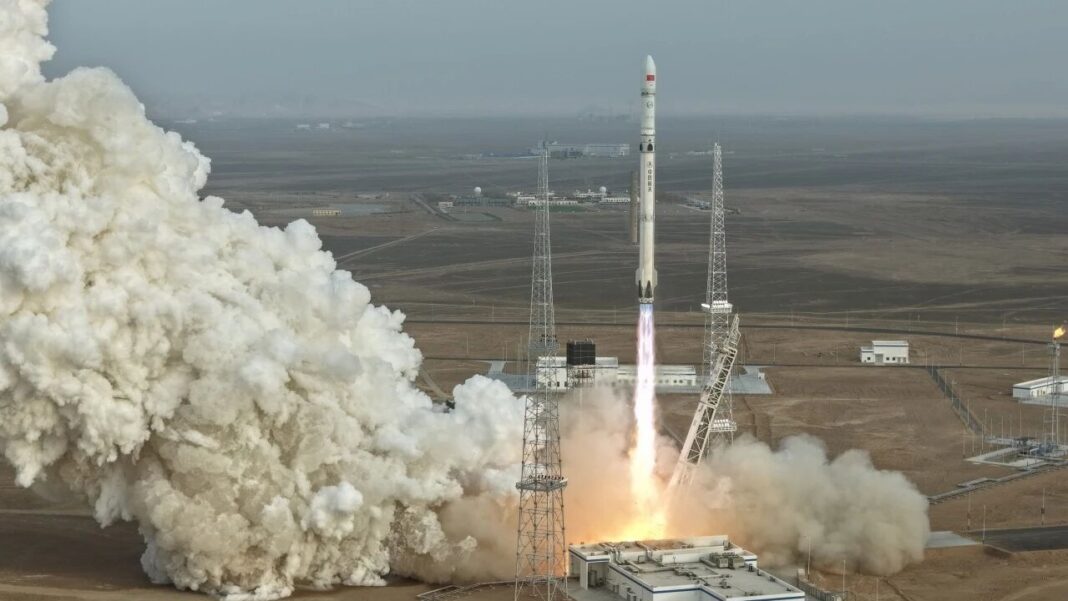

JIUQUAN, China — China successfully launched its first Long March 12A rocket into orbit on Monday, marking the nation’s second attempt at a reusable launch within three weeks. While the rocket’s upper stage successfully delivered its payload to the intended orbit, the methane-fueled first-stage booster failed to complete its recovery sequence.
The booster plummeted through the atmosphere at supersonic speeds before impacting the Gobi Desert, approximately 200 miles downrange from the Jiuquan Satellite Launch Center. According to the state-owned China Aerospace Science and Technology Corporation (CASC), the booster failed to execute a critical braking burn required for a controlled landing.
Despite the recovery failure, CASC officials characterized the mission as an “important foundation” for future reusable operations, noting that the flight provided essential engineering data. This mission mirrors the December 2 debut of LandSpace’s Zhuque-3, another medium-class reusable rocket that reached orbit but saw its booster crash during its landing attempt.
These launches signal China’s aggressive move toward propulsive landing architectures similar to those pioneered by SpaceX. While Chinese rockets have completed 89 orbital attempts in 2025—roughly half the volume of U.S. launches—the country’s rapid development of reusable technology aims to drastically reduce costs and increase launch frequency.
Emerging Reusable Fleet
The Long March 12A is part of a growing ecosystem of Chinese reusable launch vehicles expected to debut in the coming years:
- Tianlong-3 & Kinetica-3: Commercial rockets from private startups slated for maiden flights in early 2026.
- Pallas-1, Hyperbola-3, & Nebula-1: Additional reusable models projected to fly by 2026.
- Long March 10: A super-heavy vehicle designed with reusable boosters to transport crewed spacecraft to the Moon.
- Long March 9: A fully reusable heavy-lift rocket, comparable to SpaceX’s Starship, currently targeted for a 2030s debut.