

Recent discoveries of a group of microbes called Asgard archaea are revolutionizing our understanding of how complex life—including humans, animals, and plants—first evolved. These single-celled organisms, first identified in 2015 from sediments near Arctic hydrothermal vents, possess genetic signatures previously thought to be exclusive to eukaryotes (complex cells with nuclei). This genetic overlap suggests that complex life did not emerge from a freak accident, but rather through a gradual evolutionary process where an ancient Asgard archaean host merged with a bacterium.
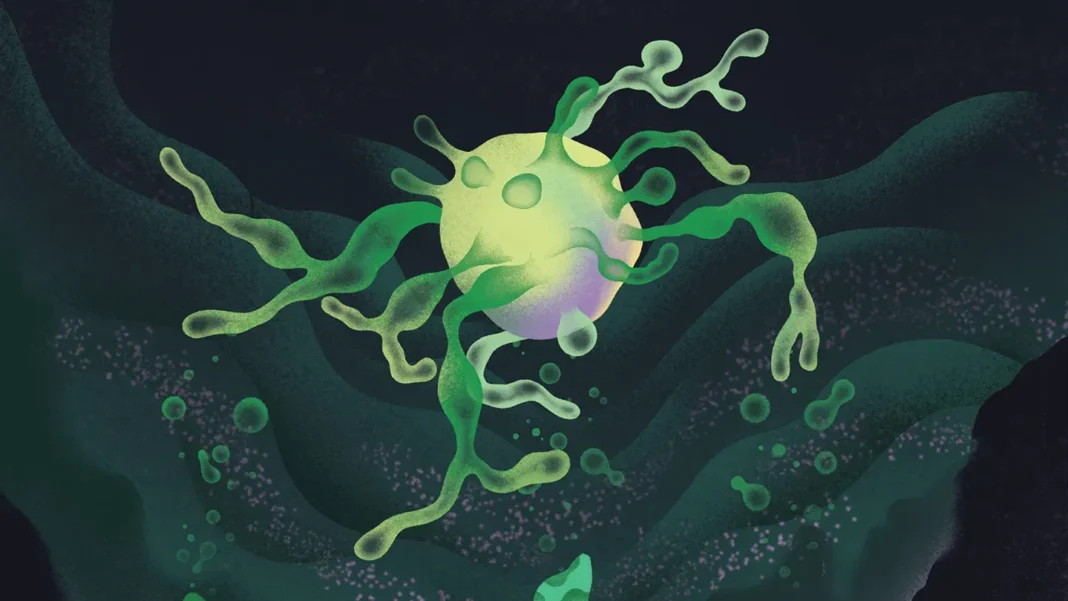
Laboratories have recently succeeded in culturing these “Asgardians,” revealing strange, tentacle-like protrusions. Scientists now propose these appendages were used to “grab” and eventually engulf bacterial partners in a symbiotic relationship known as endosymbiosis. If this transition from simple to complex life is an inherent evolutionary trait rather than a one-time miracle, it significantly increases the statistical probability that complex extraterrestrial life exists elsewhere in the cosmos.
The Evolutionary Bridge: From Primordial Slime to Complexity
The transition from simple, single-celled organisms to the vast biological diversity we see today—from towering redwoods to great white sharks—represents the most profound “discontinuity” in evolutionary history. For decades, the “endosymbiotic theory” suggested that complex cells formed when one cell took up residence inside another, eventually becoming the energy-producing mitochondria we rely on today. However, the identity of the original host cell remained a “missing link” until the discovery of Asgard archaea.
These microbes serve as a biological bridge. For example, researchers found that Asgard archaea contain actin, a protein used by complex cells to build internal scaffolding (the cytoskeleton). In a real-world parallel to how our own white blood cells operate, these ancient microbes may have used their flexible membranes to interact with and eventually internalize other cells. This suggests that the “machinery” for complexity was already present in simple organisms long before the first true eukaryote appeared. Furthermore, the fact that these organisms are found globally—from the hot springs of Yellowstone to the depths of the South China Sea—indicates that the precursors for complex life are ubiquitous, rather than confined to a single, lucky environment.