

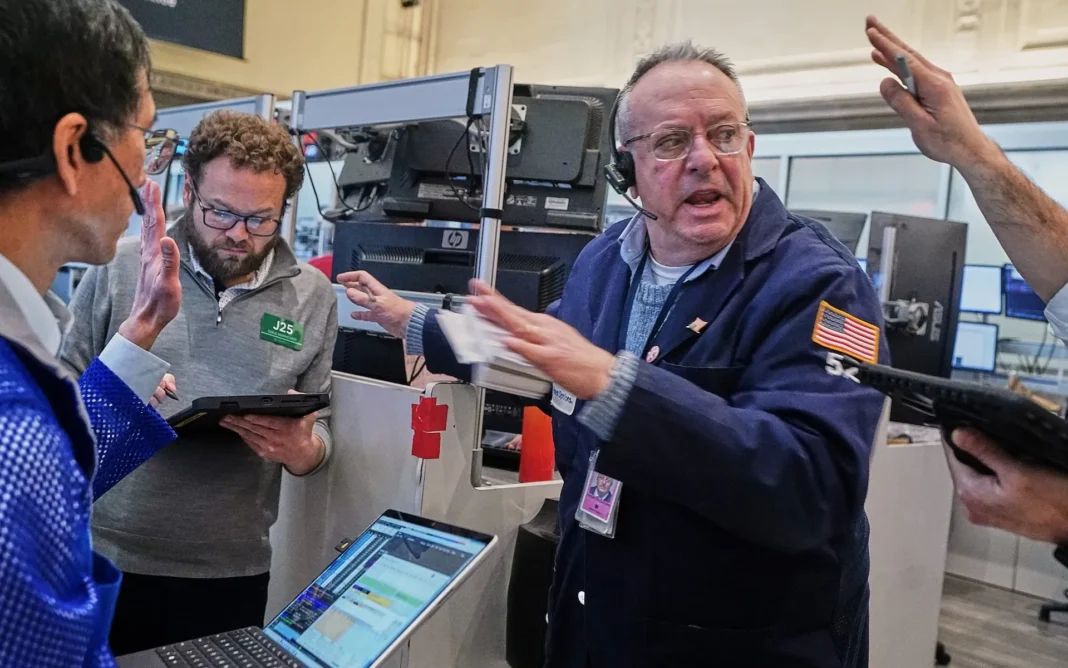

The “AI gold rush” faced a sobering reality check this week as a massive sell-off wiped approximately £586 billion ($800bn) off the Nasdaq, sending shockwaves through London’s financial district. What began as a frenzy for artificial intelligence has pivoted into a “firesale” of software and semiconductor stocks, driven by growing anxiety that the technology may cannibalise the very industries it was meant to revolutionise.
Disruption Fears Trigger Software ‘Exodus’
The primary catalyst for the downturn appears to be a shift in investor sentiment regarding the longevity of traditional software models. Following a move by AI firm Anthropic to automate complex tasks in legal, financial, and marketing sectors, traders moved to offload shares in established providers.
Nay Soe Naing, a technology analyst at Berenberg, characterised the movement as an ongoing “let’s get out of software” trade. This sentiment was felt acutely by global players:
- Palantir: Shares plummeted by more than 13%, despite the firm posting strong revenue growth.
- AMD: The chipmaker crashed 17% after forecasting a revenue slowdown, missing high-altitude market expectations.
- AppLovin: The mobile app specialist slumped by 15%.
UK Blue-Chips Caught in the Crossfire
While the epicentre of the rout was Wall Street, the FTSE 100 did not escape the contagion. Several high-profile British firms saw their share prices extended into a downward trajectory as the market grappled with AI’s potential to “sidestep” traditional agencies and service providers.
Advertising powerhouse WPP tumbled to its lowest valuation since 1998, amid fears that AI could replace the core functions of creative agencies. Other notable UK fallers included the online property portal Rightmove, data giant Relx, and the educational publisher Pearson. Even the London Stock Exchange Group and software firm Sage faced pressure as investors reassessed the threat of AI redundancy.
An ‘Internally Inconsistent’ Market
Despite the tech-heavy gloom, the FTSE 100 actually reached a fresh record high on Wednesday, buoyed by domestic merger and acquisition activity, such as Zurich’s £8bn pursuit of insurer Beazley.
Analysts at Bank of America have described the current market volatility as “internally inconsistent”. Traders appear to be simultaneously worried that AI will replace software (bad for software firms) and that demand for AI is slowing (bad for chipmakers). Jensen Huang, CEO of Nvidia, dismissed the software sell-off as “the most illogical thing in the world,” arguing that AI will act as a tool to enhance software rather than a replacement for it.
Insightful Analysis: The UK Perspective
For the UK, this volatility underscores a precarious balance. As a global hub for professional services, law, and advertising, the London market is uniquely exposed to “automation anxiety.” While the FTSE 100’s diversification into insurance and gambling provided a temporary buffer this week, the long-term pressure on British mainstays like WPP and Sage suggests that UK PLC must rapidly integrate AI to prove its continued relevance to cautious shareholders.
The cautionary words of Niall Gallagher at Jupiter Asset Management ring particularly true for British investors: while technology eventually changes the world, “it doesn’t happen overnight”.