
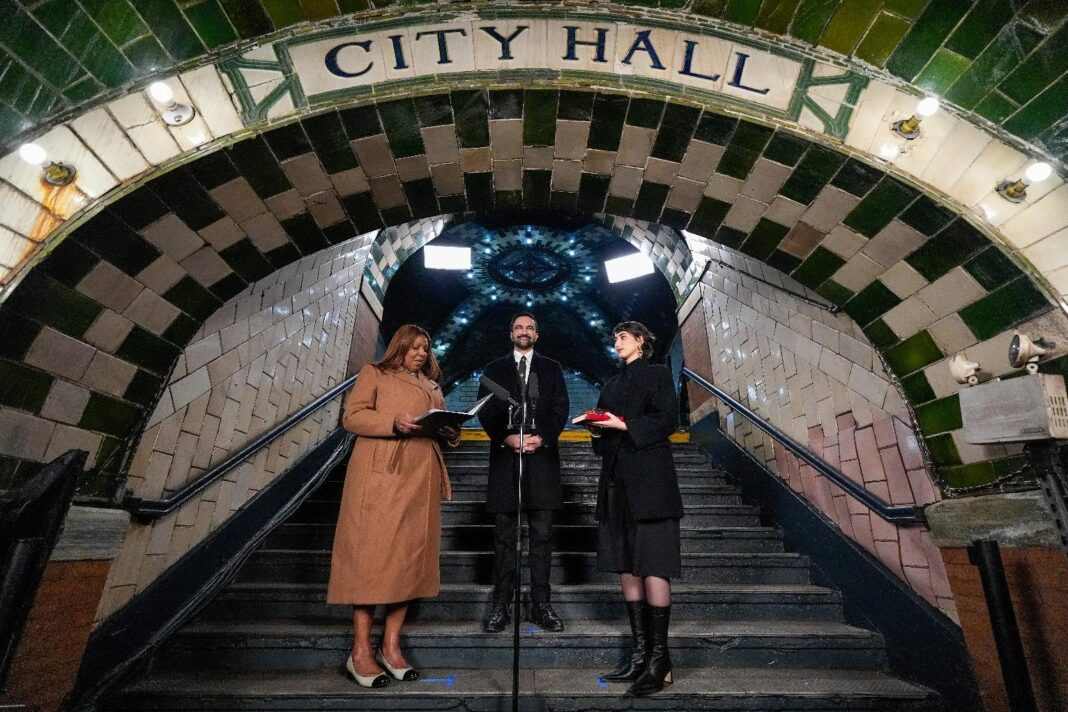

NEW YORK — Zohran Mamdani, a 34-year-old democratic socialist, was inaugurated as New York City’s mayor shortly after midnight Thursday during a private ceremony at the historic, decommissioned City Hall subway station. Administered by Attorney General Letitia James, the oath saw Mamdani—the city’s first Muslim, first South Asian, and first African-born leader—place his hand on a Quran. During the ceremony, Mamdani underscored the vital role of public transit and appointed Mike Flynn as the new Department of Transportation commissioner.
A second, public inauguration will take place at 1 p.m. at City Hall, officiated by U.S. Sen. Bernie Sanders. The event precedes a “Canyon of Heroes” block party on Broadway. Mamdani’s ambitious “affordability” platform includes free child care, free bus fare, a rent freeze for one million households, and city-run grocery stores.
While Mamdani inherits a city with rebounding tourism and low violent crime, he faces immediate challenges regarding high living costs and potential friction with President Donald Trump over immigration policy. To stabilize his transition, Mamdani retained Police Commissioner Jessica Tisch, a move aimed at reassuring the business community.
Analysis: A Progressive Shift in the Five Boroughs
The ascension of Zohran Mamdani represents a seismic shift in New York City’s political landscape, signaling a move toward democratic socialism in executive governance. His “affordability” mandate addresses a crisis seen in global hubs like London or San Francisco, where the working class is increasingly priced out. For instance, his proposed rent freeze for one million households mirrors radical housing interventions aimed at halting gentrification, while city-run grocery stores represent a direct challenge to “food deserts” and corporate retail dominance.
However, Mamdani must navigate a complex geopolitical and federal minefield. His criticisms of the Israeli government have created friction with segments of the Jewish community, requiring delicate diplomacy to maintain a broad coalition. Simultaneously, his relationship with President Donald Trump remains a volatile variable. Despite a “cordial” November meeting, the fundamental divergence on immigration—specifically New York’s status as a sanctuary city—suggests that federal funding battles and threats of National Guard intervention remain a possibility. By retaining seasoned officials like Jessica Tisch, Mamdani is attempting a “radical yet responsible” synthesis, balancing transformative social policy with the institutional stability required to manage a global alpha city.