


In a feat of engineering that reads like science fiction, Japan has just struck “black gold” at the bottom of the Pacific—a move that could finally dismantle China’s decade-long chokehold on the world’s high-tech supply chain.
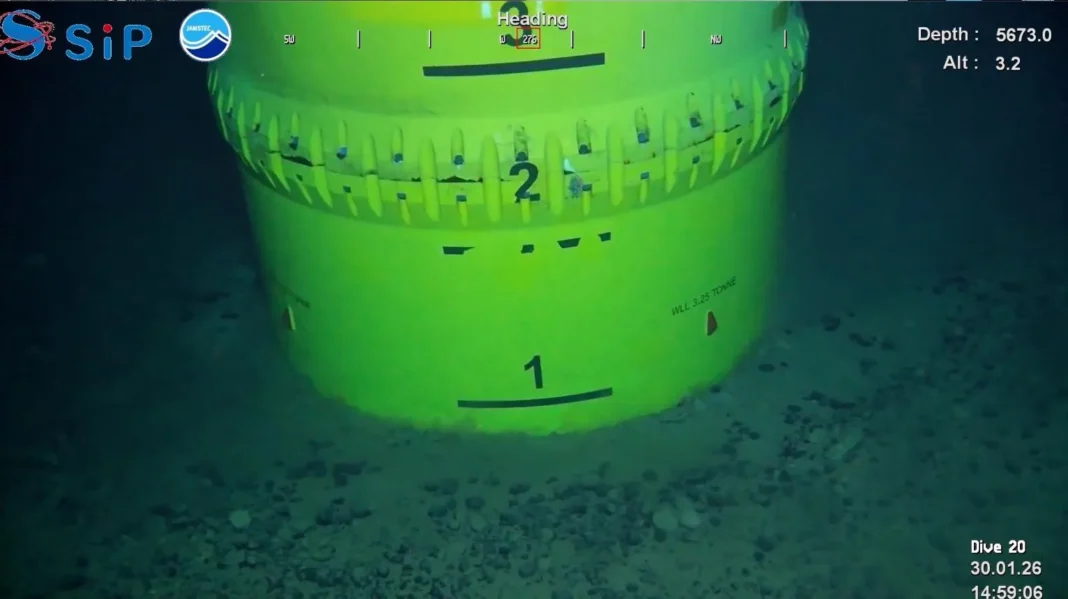
On Monday, the Japanese government announced the successful retrieval of rare earth-rich sediment from a staggering depth of nearly 6,000 meters (roughly 3.7 miles) near the remote island of Minamitorishima. This world-first achievement isn’t just a win for Tokyo; it’s a massive siren call for U.S. defense and EV industries currently tethered to Chinese exports.
Breaking the “Great Wall” of Minerals
For years, China has dominated the production of the 17 elements classified as “rare earths,” which are essential for everything from Tesla motors and wind turbines to the precision-guided missiles used by the U.S. military. Beijing hasn’t been afraid to weaponize this dominance, recently suspending exports of “dual-use” goods to Japan—a move many fear is a prelude to a full-blown rare earth embargo.
The discovery near Minamitorishima is a direct answer to that threat. Researchers estimate these seabed deposits contain enough critical minerals to fuel global demand for hundreds of years.
The Engineering Titan: The Chikyu
The vessel behind this historic operation is the Chikyu (Japanese for “Earth”), a deep-sea scientific drilling ship designed to push the boundaries of the planet’s crust.
- Target Depth: Nearly 6,000 meters below the surface.
- Mission Site: Minamitorishima, a remote Pacific outpost 1,210 miles southeast of Tokyo.
- The Prize: Sediment packed with heavy rare earths like dysprosium and yttrium, critical for high-strength magnets and lasers.
Japan’s Deputy Chief Cabinet Secretary Masanao Ozaki hailed the mission as a “meaningful achievement for economic security”. However, the road from “mud to magnets” is still long. The next phase requires demonstrating that these minerals can be separated and refined at an industrial scale that is economically viable.
Why This Matters: The Insightful Take
This isn’t just a mining story; it’s a geopolitical chess move. For the United States, Japan’s success provides a blueprint for “friend-shoring”—the practice of building supply chains within allied nations to avoid overdependence on adversaries.
If Japan can industrialize this process, it effectively neutralizes China’s ability to “turn off the lights” on Western technology. While the U.S. identifies 50 minerals as “critical,” the 17 rare earths are the hardest to replace. A domestic, allied source of these elements would be a catastrophic blow to Beijing’s strategic leverage.
Takeaways
- World-First Tech: Japan is the first to successfully retrieve rare earth sediment from such extreme depths.
- Supply Chain Resilience: The project aims to build a “resilient supply chain” to bypass Chinese export controls.
- Massive Potential: The deposits could last for centuries, potentially shifting the global balance of power in mineral wealth.
- Geopolitical Friction: The site is a flashpoint; Chinese naval vessels have already been spotted lurking near the mining zone.