
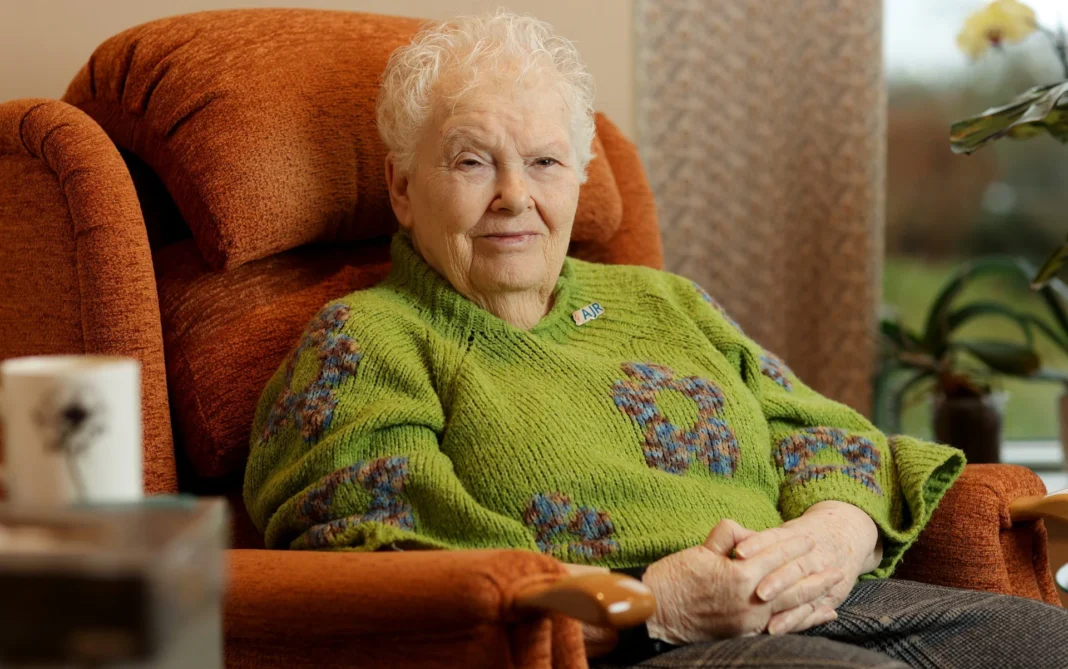

LONDON — Joanna Millan was just three years old when she was flown to the Lake District in 1945, a liberated “Windermere Child” seeking sanctuary from the ashes of the Holocaust. Today, at 83, that sanctuary feels like it is crumbling.
In a move that has sent shockwaves through Britain’s Jewish community, Mrs Millan—who has spent more than three decades educating thousands of British schoolchildren—revealed she no longer feels safe in the United Kingdom. “Obviously I’m too old to move,” she admitted from her home in North London, “but I think if I was younger, I would be considering leaving the UK.”
Her despair marks a watershed moment for a nation that has long prided itself on being a safe haven for those fleeing persecution.
A ‘Rising Tide’ of Overt Hostility
For 35 years, Mrs Millan visited roughly 100 schools annually, sharing the story of how her father was murdered at Auschwitz and her mother died in the Theresienstadt camp. However, she now questions if her life’s work has made any difference.
While antisemitism in the 1960s was often “covert,” Millan argues it has now become “overt” and socially acceptable in public discourse. She describes a recurring historical pattern, noting that the current “wave” of hostility has left her feeling less secure for her children and grandchildren.
“It’s getting worse,” she warned. “I think it was the realisation that it doesn’t seem to have made a difference, and the antisemitism is worse than ever.”
Violence on the Doorstep
The survivor’s distress is rooted in a string of recent violent attacks. In October, the British Jewish community was rocked when a vehicle was driven into the gates of the Heaton Park synagogue in Manchester during Yom Kippur—the most solemn day of the Jewish calendar. The attacker, Jihad al-Shamie, was armed with a knife and wearing a fake suicide belt; two victims were killed before police shot the perpetrator dead.
The violence has not been confined to British soil. Mrs Millan was reduced to tears by the December terror attack at Bondi Beach, Sydney, where 15 people—including 10-year-old Matilda Britvan—were killed during a Hanukkah celebration.
Analysis: The Statistics of Fear
The numbers back Mrs Millan’s intuition. The Community Security Trust (CST) recorded 1,521 antisemitic incidents in the first half of 2025 alone—the second-highest total on record. This followed a staggering 2,019 incidents in the first half of 2024.
Perhaps more alarming is the rapid decline in Holocaust remembrance within the British education system. Data from the Holocaust Memorial Day Trust shows that school participation has plummeted by nearly 60% in just two years. While over 2,000 high schools held commemorative events in 2023, that number fell to just 854 in 2025—representing only 20% of UK secondary schools.
Insightful Analysis: A Crisis of National Identity? The British government has responded by committing £54 million in funding to the CST for protective security through 2028, with an additional £10 million specifically earmarked for synagogue and school protection following the Manchester attack. However, for survivors like Millan, the issue isn’t just physical security—it’s the “normalisation” of hate. The fact that a Holocaust survivor, who arrived here as an orphan to “begin a new life,” now feels she would leave if she could, suggests a profound failure in the UK’s social contract of “Never Again.”