

A Tightrope Between Triumph and Tragedy
For 91 minutes on Sunday, the world held its collective breath as Alex Honnold, the man who famously conquered El Capitan, stared down a different kind of titan: the glass and steel of Taipei 101. In a feat that redefined “high-stakes” television, Honnold became the first person to summit the 508-metre skyscraper without a single rope or safety harness.
While the ascent was a masterclass in human performance, it has ignited a fierce debate across Canada and beyond regarding the ethics of “death-defying” entertainment in the digital age. As millions tuned in to the live Netflix broadcast, the line between athletic achievement and voyeuristic spectacle felt thinner than a ledge on the tower’s 64th floor.
Scaling the “Bamboo Boxes”
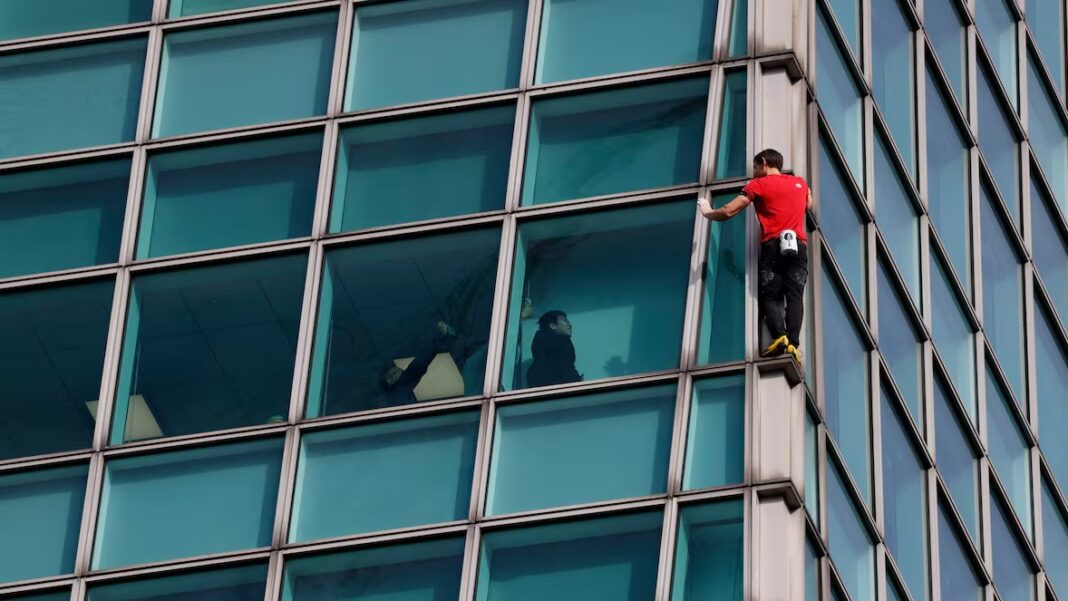
The climb was not merely a vertical slog; it was a technical puzzle comprising 101 floors of architectural complexity. Honnold navigated the building’s signature “bamboo boxes”—eight distinct segments, each featuring eight floors of overhanging metal beams.
- Height & Time: Honnold reached the peak of the 508-metre tower in approximately 1 hour and 31 minutes.
- The Technique: Using bare hands and small L-shaped metal outcroppings as footholds, he pulled himself up the building’s corner.
- The Rest Stops: Honnold utilized the building’s balconies between segments to take brief rests, occasionally turning to face the cheering crowds below in his signature red shirt.
The event was originally slated for Saturday but was pushed back 24 hours due to heavy rain—a reminder that even the most calculated risks are at the mercy of the elements.
The “Ghoulish” Lure of the 10-Second Delay
The broadcast itself was a lightning rod for criticism. To mitigate the risk of airing a fatal fall, Netflix implemented a 10-second delay on the stream. For many observers, this safety net for the viewers—but not the climber—raised uncomfortable questions.
Canadian media ethics experts have noted a growing trend toward “eventizing” extreme risk. While French climber Alain Robert scaled the same building in 2004, he did so using ropes and protective gear due to inclement weather. By removing those safety measures for a global audience, critics argue the production shifted from a sporting event to a high-consequence stunt where the primary “allure” is the potential for disaster.
National Impact: The Price of the Peak
From a Canadian perspective, where sport safety and inclusive participation are often prioritized over individual “glory” stunts, the Honnold ascent serves as a cultural Rorschach test.
- The Commercialization of Risk: Honnold reportedly received a significant mid-six-figure payout for the climb. This introduces a commercial pressure to perform that many find incompatible with pure “free soloing” values.
- The Responsibility of the Athlete: Now a father of two, Honnold’s decision to risk everything for a skyscraper has drawn sharp rebukes from those who see the act as “irresponsible” to his family.
- The “Spiderman” Legacy: While Robert’s 2004 climb was a PR stunt for the building’s opening, Honnold’s 2026 feat was a media product, signaling a shift in how we consume “extreme” human achievement.